
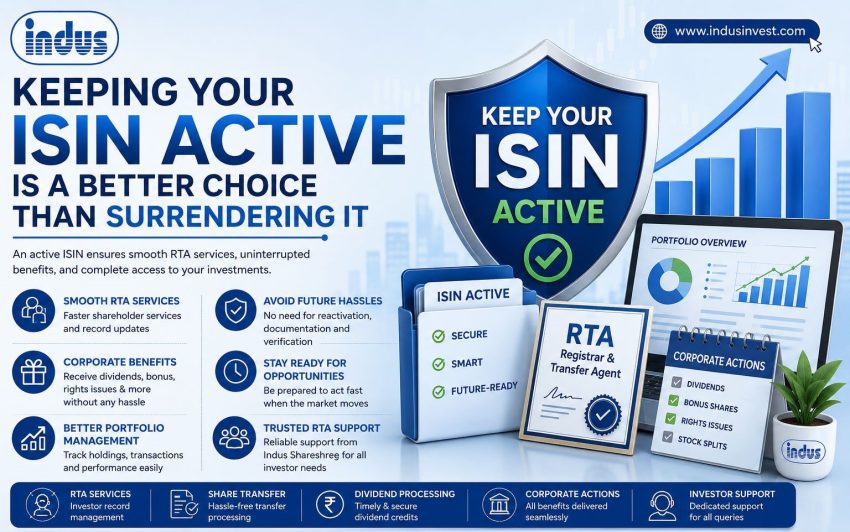
Why Issuer Companies Should Keep Their ISIN Active Instead of Surrendering It
Complete Guide for Listed Companies, Unlisted Companies, NBFCs, Startups and Debt Listed Entities
Introduction
In the modern securities market ecosystem, an International Securities Identification Number (ISIN) is far more than a technical code allotted by depositories. For issuer companies, an ISIN represents the operational identity of their securities within the depository system. Whether a company is listed, unlisted, planning fundraising, issuing debt instruments, restructuring capital, or managing shareholder records, maintaining an active ISIN plays a critical role in ensuring smooth securities management and regulatory compliance.
Many issuer companies consider surrendering or deactivating their ISIN when they are not actively issuing securities or when immediate fundraising requirements are absent. However, this approach often creates significant operational, regulatory, compliance, and business challenges in the future.
Keeping an ISIN active provides issuer companies with long-term strategic advantages including smoother corporate action processing, easier investor servicing, faster fundraising readiness, improved compliance management, better coordination with depositories, and stronger operational continuity.
For companies looking to maintain flexibility and future growth readiness, retaining an active ISIN is usually a much smarter and safer decision than surrendering it.
At Indus Shareshree Private Limited, issuer companies receive professional support for ISIN activation, corporate action management, RTA coordination, depository connectivity, compliance management, and investor servicing.
This comprehensive article explains why issuer companies should maintain active ISIN status, the operational and compliance benefits involved, the disadvantages of surrendering an ISIN, and the role of RTAs in maintaining smooth securities operations.
Understanding ISIN and Its Importance for Issuer Companies
What Is an ISIN?
ISIN stands for International Securities Identification Number. It is a unique 12-character alphanumeric code used for identifying securities electronically.
ISINs are allotted to various financial instruments such as:
- Equity Shares
- Preference Shares
- Debentures
- Bonds
- Commercial Papers
- Warrants
- Mutual Fund Units
- Government Securities
- Debt Instruments
- Structured Products
In India, ISINs are allotted through depositories such as:
- National Securities Depository Limited (NSDL)
- Central Depository Services (India) Limited (CDSL)
An ISIN serves as the digital identity of a company’s securities within the depository system.
Why ISIN Is Important for Issuer Companies
For issuer companies, an ISIN forms the foundation of securities administration and investor servicing.
An active ISIN helps companies:
- Maintain demat connectivity
- Process corporate actions efficiently
- Manage shareholder records
- Raise capital smoothly
- Coordinate with RTAs and depositories
- Facilitate transfer and transmission activities
- Maintain regulatory compliance
- Execute restructuring activities
- Handle debt securities management
- Support investor servicing operations
Without an active ISIN, many of these functions become operationally difficult and time-consuming.
Role of Registrar and Transfer Agent (RTA) in ISIN Management
A Registrar and Transfer Agent (RTA) acts as an important intermediary between issuer companies, depositories, shareholders, and regulatory authorities.
RTAs manage the operational side of securities administration.
Major RTA Functions Related to ISIN Management
Shareholder Record Maintenance
RTAs maintain:
- Shareholder databases
- Folio records
- Demat account details
- Beneficiary position records
- Contact information
- KYC records
Corporate Action Processing
RTAs process various corporate actions including:
- Bonus issues
- Rights issues
- Buyback of shares
- Preferential allotments
- ESOP allotments
- Stock splits
- Mergers and demergers
- Debt allotments
- Commercial paper redemption
- Warrant conversions
Demat and Depository Coordination
RTAs coordinate with NSDL and CDSL regarding:
- Dematerialization requests
- Rematerialization requests
- ISIN activation
- Corporate action execution
- Security reconciliation
Investor Servicing
RTAs assist companies in handling:
- Investor grievances
- Transmission requests
- Duplicate certificate requests
- KYC updation
- PAN corrections
- Bank mandate registration
- Dividend-related issues
All these activities require efficient and active ISIN infrastructure.
Why Keeping ISIN Active Is a Better Decision for Issuer Companies
Many companies believe surrendering an ISIN reduces compliance burden. In reality, surrendering an ISIN often creates future business limitations, delays, and operational difficulties.
Maintaining an active ISIN provides long-term operational and strategic advantages.
1. Smooth Corporate Action Management
One of the biggest benefits of maintaining an active ISIN is seamless corporate action execution.
Corporate actions require active coordination between issuer companies, RTAs, depositories, and investors.
Corporate Actions That Require Active ISIN
Bonus Issue
Bonus shares are credited electronically into investor demat accounts through active ISIN systems.
Rights Issue
Rights entitlement processing and allotment require operational ISIN connectivity.
Preferential Allotment
Companies issuing shares to promoters or strategic investors need active ISIN infrastructure.
ESOP Allotment
Employee stock option allotments require active ISIN management.
Buyback of Shares
Buyback settlements through tender offer or open market mechanisms require active ISIN processing.
Stock Split or Sub-Division
Face value changes and split implementation are processed through depository systems linked to ISIN.
Merger and Demerger
Corporate restructuring becomes easier when ISIN infrastructure already exists.
Debt Instrument Allotment
NCDs, bonds, and commercial papers require active ISINs for issuance and redemption.
Warrant Conversion
Conversion of warrants into equity shares requires active depository connectivity.
Lock-In Creation and Release
Depositories process lock-in instructions through active ISIN systems.
Without active ISIN infrastructure, corporate actions may face delays, compliance complications, and investor dissatisfaction.
2. Better Fundraising Readiness
An active ISIN helps companies remain prepared for future capital-raising opportunities.
Business conditions can change rapidly. A company that does not require immediate funding today may require capital tomorrow for:
- Expansion
- Acquisition
- Debt restructuring
- Working capital
- Strategic investments
- IPO preparation
- Rights issue
- Private placement
- Venture capital investment
An already active ISIN allows companies to respond quickly to funding opportunities.
Benefits of Active ISIN During Fundraising
Faster Securities Issuance
Since depository infrastructure already exists, issuance can be completed more efficiently.
Better Investor Confidence
Institutional investors prefer companies with strong compliance systems.
Reduced Documentation Burden
Fresh ISIN activation requires multiple approvals and documentation.
Stronger Corporate Governance Image
Maintaining active securities infrastructure reflects operational discipline.
An active ISIN therefore supports long-term business scalability.
3. Easier Coordination with Depositories
Issuer companies frequently coordinate with NSDL and CDSL.
An active ISIN ensures smooth communication regarding:
- Security balances
- Corporate actions
- Beneficiary position records
- Reconciliation
- Lock-in monitoring
- Allotment processing
- Redemption activities
Inactive or surrendered ISINs complicate these operational processes.
4. Efficient Shareholder Record Management
Maintaining accurate shareholder records is both a statutory requirement and an operational necessity.
An active ISIN helps companies maintain centralized and updated shareholder databases.
Benefits of Active ISIN for Shareholder Management
Accurate Beneficiary Records
Companies receive updated beneficiary position reports.
Faster Reconciliation
Demat balances can be reconciled efficiently.
Better Investor Communication
Companies can communicate effectively with shareholders.
Reduced Operational Errors
Electronic systems minimize manual processing errors.
Easier Audit Support
Auditors often require reconciled capital and demat data.
Surrendering ISINs may create fragmented records and administrative inefficiencies.
5. Stronger Regulatory Compliance
SEBI and depositories have continuously strengthened compliance requirements relating to securities management.
Keeping an ISIN active helps issuer companies remain compliance-ready.
Key Compliance Areas Supported by Active ISIN
Dematerialization Compliance
Several securities transactions now require mandatory demat connectivity.
Investor Protection Framework
Active ISIN systems support transparent and efficient investor servicing.
Capital Reconciliation Requirements
Companies must maintain reconciled share capital records.
Corporate Governance Standards
Proper securities administration reflects stronger governance practices.
Listing Compliance
Listed entities require continuous depository coordination.
Debt Securities Compliance
Debt-listed companies require operational ISIN management.
Inactive ISINs may create compliance gaps and operational risks.
6. Better Investor Servicing
Investor servicing becomes significantly easier when a company maintains active ISIN infrastructure.
Companies regularly receive investor requests relating to:
- Transmission
- Transposition
- Name correction
- KYC updates
- Demat confirmation
- Dividend claims
- Duplicate certificate issuance
- PAN correction
- Bank mandate updates
An active ISIN enables faster and smoother processing.
This improves:
- Investor confidence
- Corporate reputation
- Operational efficiency
- Regulatory standing
7. Easier IPO and Listing Preparation
Many unlisted companies eventually plan:
- IPOs
- SME listing
- Debt listing
- Institutional fundraising
- Private equity investment
Keeping an ISIN active simplifies future listing preparation.
Advantages During IPO Preparation
Existing Depository Connectivity
The company already has operational coordination with depositories.
Organized Capital Structure
Shareholding records remain properly maintained.
Easier Due Diligence
Merchant bankers and legal advisors prefer structured securities data.
Faster Compliance Readiness
Companies can avoid fresh ISIN activation delays.
Better Institutional Perception
Compliance-ready companies attract stronger investor confidence.
8. Easier Restructuring and Corporate Reorganization
Companies frequently undergo restructuring activities such as:
- Mergers
- Demergers
- Capital restructuring
- Share capital reduction
- Debt restructuring
- Promoter restructuring
- Conversion of securities
These activities require active securities infrastructure.
An active ISIN helps ensure:
- Faster implementation
- Easier reconciliation
- Smooth investor servicing
- Efficient depository coordination
- Reduced procedural delays
9. Better Operational Continuity
Business continuity is an important part of corporate governance.
An active ISIN supports continuity during:
- Management transition
- Ownership change
- Auditor reviews
- Regulatory inspections
- Investor servicing
- Corporate restructuring
Surrendering ISINs may disrupt operational continuity and future flexibility.
10. Avoiding Future Reactivation Problems
One of the biggest disadvantages of surrendering an ISIN is the future reactivation process.
Reactivation may involve:
- Fresh documentation
- Depository approvals
- Compliance verification
- Board resolutions
- Agreement execution
- RTA coordination
- Connectivity restoration
These procedures consume:
- Time
- Professional fees
- Internal resources
- Administrative effort
Maintaining an active ISIN is generally much easier and more cost-effective than reactivating it later.
Major Disadvantages of Surrendering an ISIN
1. Delay in Future Fundraising
Companies without active ISIN infrastructure may face delays in:
- Raising capital
- Bringing new investors
- Issuing securities
- Structuring debt instruments
Potential investors may also view inactive securities infrastructure negatively.
2. Operational Delays in Corporate Actions
If a company later decides to undertake corporate actions, inactive ISIN status may create:
- Approval delays
- Compliance complications
- Documentation burden
- Investor servicing issues
3. Increased Compliance Complexity
Reactivation may require:
- Fresh agreements
- Updated KYC
- Regulatory verification
- Compliance certificates
- Depository approvals
This increases operational burden.
4. Negative Market Perception
Investors often associate active securities infrastructure with better governance.
Inactive ISIN status may create concerns regarding:
- Operational preparedness
- Compliance culture
- Business continuity
5. Additional Future Costs
Although companies may believe surrendering an ISIN reduces costs, future reactivation may involve:
- Professional charges
- Administrative expenses
- Compliance costs
- Opportunity losses
6. Difficulty in Legacy Shareholder Servicing
Companies with historical shareholders may continue receiving requests regarding:
- Transmission
- Dividend claims
- Demat requests
- Legal heir claims
- Unclaimed shares
Without active ISIN infrastructure, these processes become difficult to manage.
Industries That Benefit Most from Active ISIN
NBFCs
NBFCs regularly issue:
- Debt securities
- Preference shares
- Commercial papers
- Structured instruments
Active ISIN management supports smooth operations.
Unlisted Public Companies
Many unlisted companies eventually:
- Raise private capital
- Convert into listed entities
- Restructure ownership
An active ISIN supports these activities.
Startups and Growth Companies
Startups often require:
- ESOP issuance
- Venture capital funding
- Equity restructuring
- Strategic investments
Active ISIN infrastructure supports scalability.
Listed Companies
Listed companies require continuous depository coordination and investor servicing.
Debt Listed Companies
Debt-listed entities require active ISINs for:
- Interest payments
- Redemption processing
- Reconciliation
- Security management
Best Practices for Maintaining Active ISIN Efficiently
Maintain Proper RTA Coordination
Regular coordination with RTAs helps ensure:
- Timely compliance
- Efficient corporate action execution
- Faster issue resolution
- Accurate investor servicing
Indus Shareshree Private Limited assists issuer companies in maintaining seamless RTA operations.
Keep Shareholder Records Updated
Companies should regularly update:
- Shareholding data
- Beneficiary records
- KYC information
- Contact details
Accurate records reduce operational risk.
Monitor Regulatory Changes
SEBI and depository regulations evolve regularly.
Companies should remain updated regarding:
- Demat requirements
- Corporate action procedures
- Investor servicing norms
- Reconciliation requirements
Conduct Periodic Reconciliation
Regular reconciliation between:
- Issued capital
- Demat balances
- Beneficiary position records
helps maintain compliance accuracy.
Maintain Proper Documentation
Companies should preserve:
- ISIN activation records
- Depository agreements
- Board resolutions
- Corporate action approvals
- Audit reports
- Reconciliation statements
Proper documentation supports smooth future operations.
Why Professional RTA Support Matters
Managing ISIN operations internally can become complex due to evolving regulatory requirements and operational responsibilities.
Professional RTA support helps companies:
- Reduce compliance risks
- Improve operational efficiency
- Handle investor servicing smoothly
- Execute corporate actions accurately
- Maintain depository coordination
- Prepare for future fundraising
Indus Shareshree Private Limited provides comprehensive support for issuer companies in:
- ISIN activation
- Corporate action processing
- Depository coordination
- Investor servicing
- Compliance management
- Shareholder record maintenance
- Debt instrument management
- RTA operations
Conclusion
Keeping an ISIN active is a smart long-term business decision for issuer companies. An active ISIN supports operational continuity, regulatory compliance, efficient investor servicing, seamless corporate action execution, and future fundraising readiness.
Surrendering an ISIN may appear to reduce short-term operational responsibility, but it often creates long-term complications including reactivation delays, additional compliance burden, operational inefficiencies, and lost business flexibility.
Whether a company is listed, unlisted, debt-listed, restructuring, fundraising, or planning future expansion, maintaining active ISIN infrastructure ensures smoother securities management and stronger market preparedness.
With expert assistance from Indus Shareshree Private Limited, issuer companies can confidently manage ISIN operations, RTA coordination, corporate actions, and depository compliance while building a stronger foundation for future growth.
FAQs
Que. 1 What is the importance of ISIN for issuer companies?
ISIN helps issuer companies manage securities electronically, process corporate actions, maintain investor records, and coordinate with depositories efficiently.
Que. 2 Why should issuer companies keep their ISIN active?
Keeping an ISIN active helps companies maintain compliance readiness, execute corporate actions smoothly, support investor servicing, and remain prepared for future fundraising opportunities.
Que. 3 What are the disadvantages of surrendering an ISIN?
Surrendering an ISIN may create future operational delays, compliance complications, investor servicing difficulties and reactivation expenses.
Que. 4 How does an active ISIN help during corporate actions?
An active ISIN enables smooth processing of bonus issues, rights issues, buybacks, stock splits, mergers, debt allotments, and other corporate actions through depositories.
Que. 5 How does an RTA help in ISIN management?
RTAs help issuer companies manage shareholder records, corporate actions, depository coordination, investor servicing, and securities compliance.
Que. 6 Why choose Indus Shareshree Private Limited?
Indus Shareshree Private Limited provides professional support for ISIN management, RTA services, corporate actions, investor servicing and depository coordination for issuer companies.